Arriving in Santiago de Compostela
What a beautiful place to end your Camino ....
relax and enjoy the sites, cuisine and entertainment this wonderful city has to offer.
Santiago de Compostela: "Town of the Apostle"
History Sightseeing Gastronomy Folklore
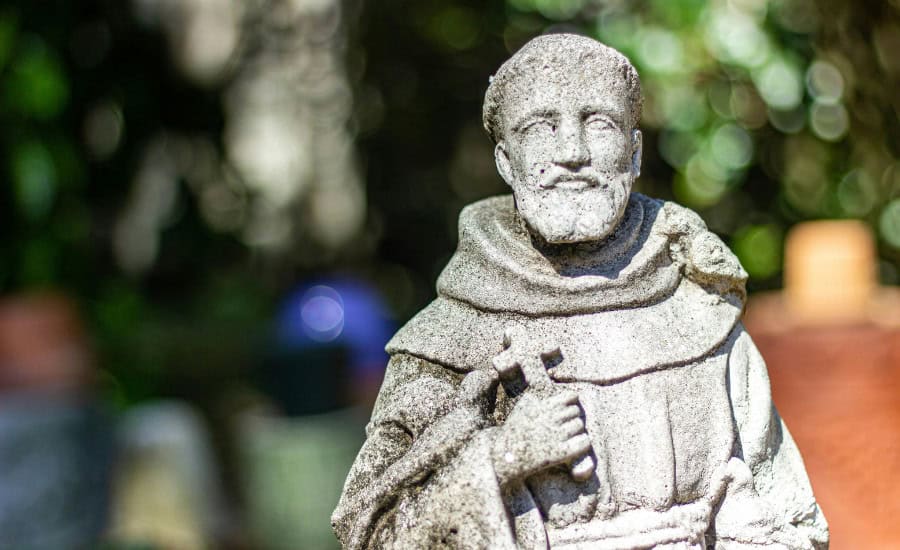
Santiago de Compostela is the final destination of the legendary medieval Camino de Santiago (Way of Saint James), now considered by Unesco a World Heritage Site. Today it attracts visitors from all over the world. The town is named after the Apostle Saint James ("Santiago"), who is buried here.
Santiago is certainly one of Spain's most monumental towns, with a particular architectural style all of its own. But it is also a very lively town with one of the most famous Universities and a large number of students who guarantee youthful ambience in between the historical walls. Also the region's cuisine is of great reputation, and it is said that nowhere you can eat better sea-food than in Galicia.
So Santiago has something for everyone with its varied attractions and is one of the great cultural centres of the world.
The name "Santiago de Compostela"
The name Santiago g
oes back to the Apostle James (Saint James = Santiago) who went to this most north-western part of Spain, called by the Romans "Finis Terrae", "end of the world", to preach and convert people to Christianity.
After returning to Palestine in 44 a.C., he was taken prisoner and tortured to death. The king refused to bury him so his disciples stole the body and brought him by boat to the Spanish coast. Here the Apostle was buried at a secret place in a wood.
Centuries later, in 813, the hermit Pelayo heard music in that wood and witnessed strange lights in the night sky. The site was thus called, in Latin, "Campus Stellae", field of the star, a name that later became Compostela.
Sightseeing in Santiago
Cathedral of Santiago de Compostela - History

News of the Hermit`s sighting in the Campus Stellae instigated an investigation, and so the tomb of the Apostle was discovered. King Alphonse II declared Saint James the patron of his empire and had a chapel built at that place. More and more pilgrims followed the way of Santiago, and the original chapel soon became the cathedral of the new settlement, Santiago de Compostela.
In the 12th and 13th century the town developed great importance, and Pope Alexander III declared it a Holy Town, like Rome and Jerusalem. Pope Calixto II declared that the pilgrims who went to Santiago in a Holy Year should be free of all their sins. El Año Santo (Holy Year) is celebrated when the Apostol's day (July, 25) is a Sunday.
Cathedral of Santiago- architecture

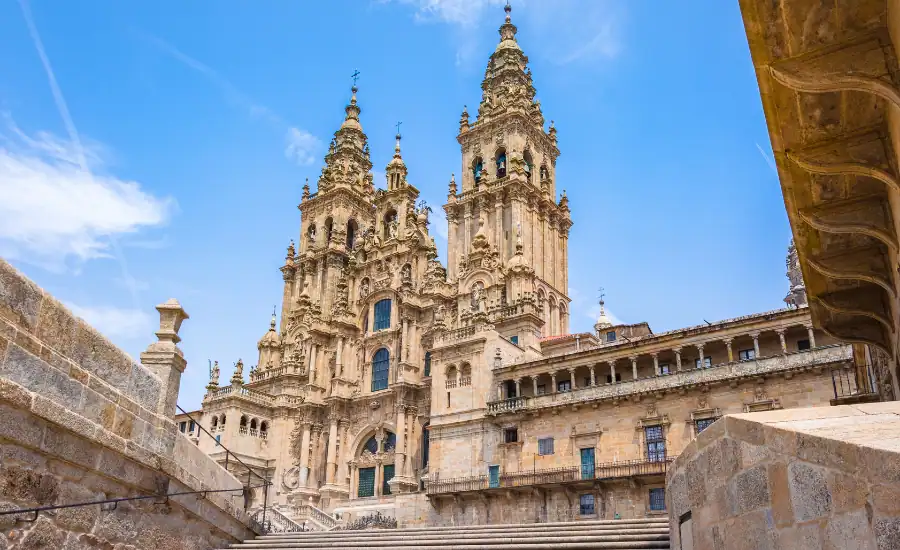
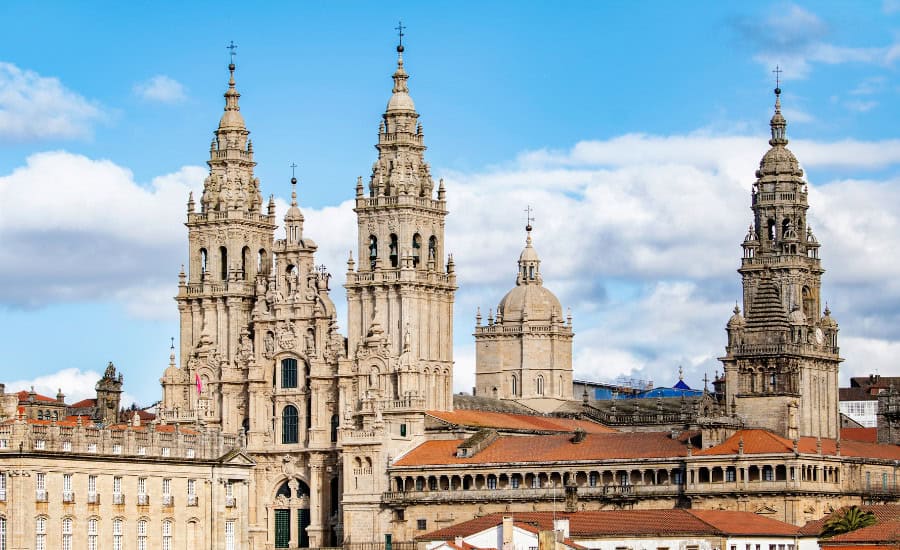
The most impressive piece of architecture in Santiago de Compostela is undoubtedly its Cathedral . The construction of this church began in the 11th century. The interior is decidedly Romanesque in style, but the exterior façade is Baroque. One of the main attractions of this cathedral is the 12th century Portico da Gloria. In recent years, it has become particularly significant to pilgrims that reach this cathedral at the end El Camino de Santiago. One of the three rites that most pilgrims perform on arrival is to touch a certain place on the column. So many pilgrims have laid their hands here to rest their weary bones that a groove has been worn in the stone. Other notable features of the cathedral are the two towers, which were built over a span of several hundred years.
There are many squares and plazas throughout the city, but the most important are located around the Santiago Cathedral. The Plaza del Obradoiro is the gathering place for pilgrims during the feast day of St. James; The name of this square is said to come from "Obra de Oro" (work of gold). It forms the center of a town.

Another major architectural attraction in Santiago is the Rajoy Palace, which faces the cathedral on El Obradioro Square. The four-story granite building has an arched walkway, central columns and a triangular neo-classic feature of the apostle St. James.
Santiago de Compostela: Gastronomy
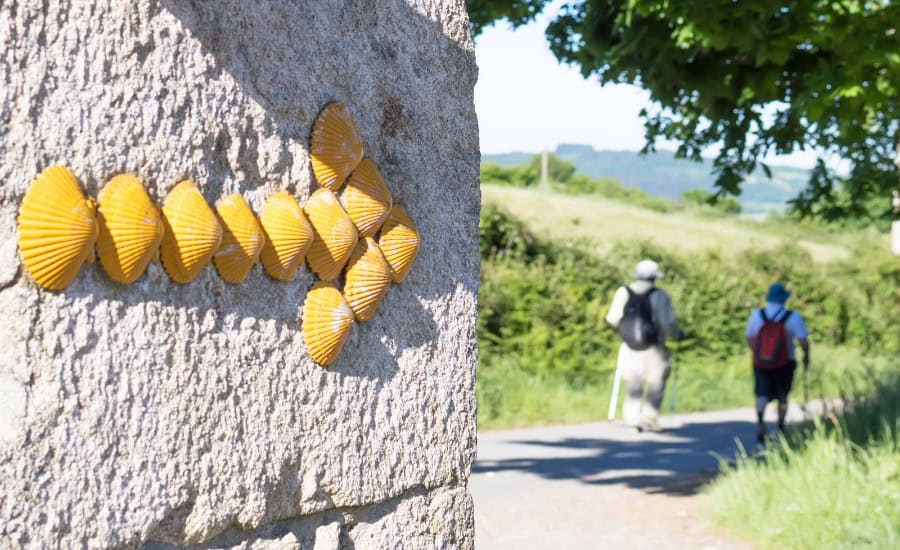
To speak about the cuisine of Santiago is not possible without considering the gastronomy of the entire region of Galicia, which has an outstanding reputation in all Spain. The region boasts an extraordinary quality and variety of seafood.The Scallop Shell, is not only the symbol of the town, but also a first rate speciality. Other local dishes include Pulpo á la Gallega, (octopus prepared with paprika) and Empanada Gallega, a pie of fish, meat or vegetables.
The Tarta Compostelana, a tart of almonds, is the most popular local dessert.
The wines of the region have a great reputation too, specially Ribeiro, young and fresh, but also worth a try are Fefiñanes, Betanzos, Rosal, Valdeorras, Ulla and Amandi.
The old town
In Rua del Franco and its side-streets there are numerous restaurants, bars and traditional taverns, where you will be able to try the delicious "Pulpo á la Gallega" and Ribeiro wine offered there. Santiago is a very important University town - and "Tunas", traditional groups of students in medieval dress, provide entertainment as they perform their serenades going from bar to bar.
El Ensanche
Around Plaza Roja in particular there are many fashionable bars, pubs, discotheques as well as 1920s style cafés. There is something in Santiago for everyone.
Santiago de Compostela: Fiestas and Folklore
Santiago is one of the most famous places of pilgrimage worldwide, so of course many of its traditional festivities are of religious character.
Semana Santa, Easterweek, is celebrated as in most major Spanish towns with impressive processions.
In May the Feria del Ganado takes place and lasts for 10 days. Apart of performances by traditional folklore groups it is also a culinary festival, giving everyone a great opportunity to try all the specialities of the regional cuisine.
If you are in Santiago at the end of July, don't miss the Festival of the Apostle. On July, 24th the "Fuego del Apostol", great fire-works display, takes place in front of the Obradoiro-door of the cathedral. The next day, during mass, a huge incense font (the "botafumeiro") that is fixed to the ceiling of the cathedral with a rope is swung through all the nave. (see video of Botafumeiro)
In August and September there is the important Festival of Classical Music with numerous concerts.
back to top back to Home Page Other places of interest along the way
External sources include :
All about Spain
http://www.red2000.com/spain/santiago/history.html
Traveller article - http://www.tripadvisor.com/Travel-g187508-c18012/Santiago-De-Compostela:Spain:Architecture.html